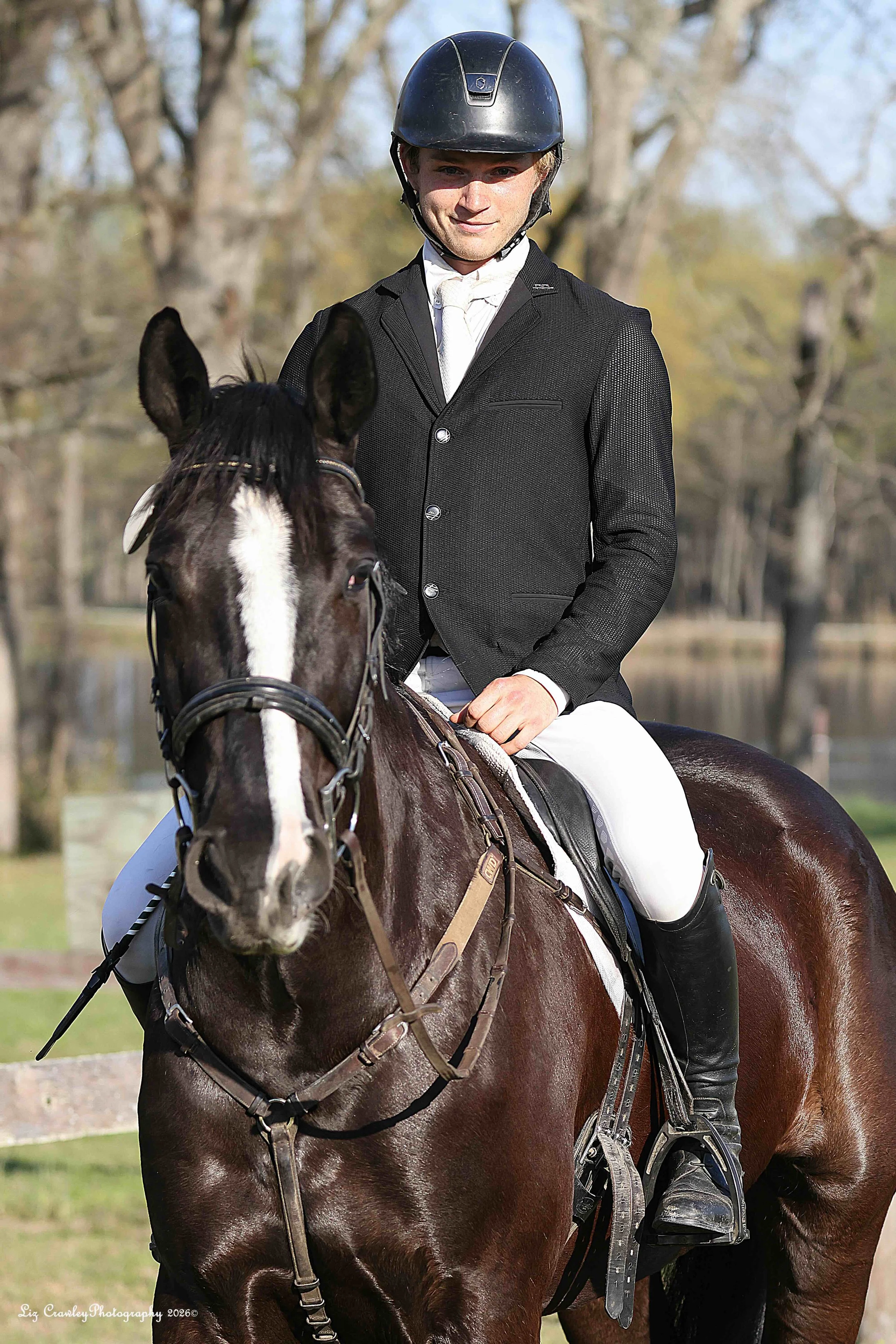
Sol Edwards (21) pictured on WHF Zorro at Pine Top 2026 Spring Horse Trials (Thomson, GA)
photo credit: Liz Crawley Photography
The Making of Solomon Edwards
Long before Solomon “Sol” Edwards ever galloped a cross-country course, he was a fixture at Pine Top Farm—just not in the way you might expect.
He was the kid tearing across the show grounds on a bicycle, slipping into the show office to raid the candy stash, and—on at least one memorable occasion—climbing in and out of a scrap metal dumpster. At the time, a threatened “yellow card” meant very little to him.
Now 21, Edwards has traded childhood antics for serious ambition. With icy blue eyes, quiet confidence, and a focused intensity, he’s setting his sights on the top of the sport: one day competing at the five-star level at Kentucky Land Rover. But his story isn’t one of sudden arrival—it’s one rooted in legacy, shaped by discipline, and refined through years spent at one of the sport’s most iconic venues.
A Family Legacy
For Edwards, horses were never a choice—they were a birthright.
His grandmother, Julie Edwards, founded Willow Hill Farm in Keesville, New York, in 1970, building a program around a simple but powerful philosophy: “the whole world of the horse to the child.” An accomplished bronze-level dressage and eventing rider, she set the foundation for what would become a multi-generational commitment to the sport.
Her daughter, Tawn Edwards, carried that legacy south, establishing Willow South Riding School in Johns Creek, Georgia, and becoming a consistent presence at Pine Top Farm beginning in 2000.
By the time Sol was born in 2004, Pine Top was already part of the family rhythm—and he grew up alongside it.
Growing Up Pine Top
“I’ve basically been coming here my whole life,” Edwards said, laughing as he recalled his younger years.
Those early days weren’t spent in competition, but in observation—and mischief. He remembers strategizing ways around show secretary Gwen Urbanik’s daily candy limits and testing the patience of officials across the property.
He also jokes that he’s responsible for at least one unofficial rule: no motorized bicycles on cross-country.
As the story goes, a young Edwards once rode straight onto the course during Advanced competition, weaving through galloping horses as announcers urgently called for “whoever is riding the bicycle” to exit immediately. Fence judges were dispatched with instructions to “stop that bike!”
He didn’t realize the gravity of the situation until he reached the water complex.
“That’s when I thought, ‘Oh… I’m in trouble now,’” he said.
Climbing the Levels
By age seven, Edwards had swapped his bike for a pony and entered his first Pine Top competition. From there, his progression was steady—and serious.
At 20, he reached the Advanced level with Graffique, a horse purchased from Caroline Martin Pamukcu. Though the horse has since stepped back from upper-level competition, the milestone marked a significant moment in Edwards’ development.
Now, his focus is on the future—and on a young Irish Sport Horse gelding, Quidam River “Freddie.”
“I try not to put expectations on him,” Edwards said. “Of course I’d love for him to go Advanced, but you just don’t know. If you plan too far ahead, you end up putting pressure on both yourself and the horse. I’d rather take him as far as he wants to go.”
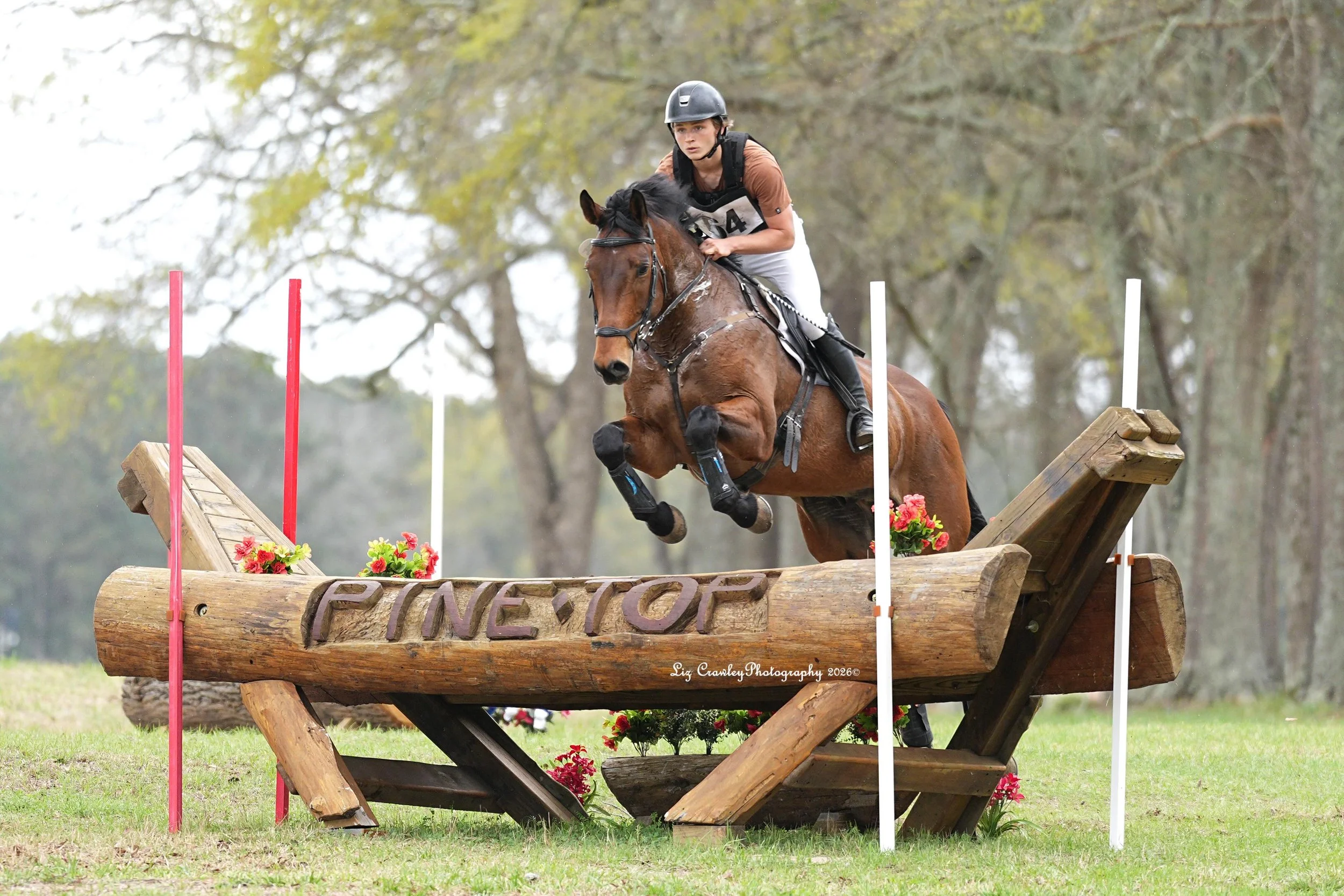
Solomon Edwards (21) riding Quidam River on the training cross-country course at Pine Top 2026 Spring Horse Trials (Thomson, GA)
photo credit: Liz Crawley Photography
Philosophy Over Results
At a time when many young riders are driven by rankings and ribbons, Edwards takes a more measured approach.
“My goal when I enter a show is to gain information,” he said. “Not ego, not the ribbon—just information.”
That mindset aligns closely with Pine Top itself, a venue he holds in especially high regard.
“It’s one of my top three cross-country courses in the world,” he said. “The footing, the terrain, the design—it’s the perfect storm. And the way the calendar is spaced, it really helps you develop a horse properly.”
For the Edwards family, Pine Top represents something even deeper.
“For us—and for so many others—it’s where we define the sport of eventing,” Tawn said.
Lessons in the Dirt
Of course, growth in eventing rarely comes without setbacks.
One of Edwards’ most vivid memories involves a Preliminary course and a ditch combination known as the “cowboy campfire.” Getting too far up his horse’s neck on approach, he was abruptly launched into the bottom of the ditch when the horse stopped.
He still has the photo—upside down, reins in hand, suspended midair.
“I actually got the same stop there this weekend,” he admitted with a laugh. “So clearly, I’ve still got work to do.”
For Edwards, those moments aren’t failures—they’re feedback.
“You have to make sure the horse is balanced and off its shoulders going into something like that,” he said. “If they’re flat, you can really scare them.”
A Student of the Sport
Edwards is candid about his own challenges as a rider.
“I’m a difficult student,” he said. “I’ve been told that—and I feel it myself.”
But with maturity has come focus. He now seeks out instruction more deliberately, training in dressage with Carol Bishop and leaning more on the guidance of his mother.
Tawn, in turn, sees both precision and complexity in her son’s riding style.
“He never rides by the seat of his pants,” she said. “He’s very calculated, especially in jumping. In dressage, he can overthink the training and underprepare for the test—but when it comes to jumping, he doesn’t leave anything to chance.”
Built, Not Given
Despite being a third-generation equestrian, Edwards’ path has been anything but easy.
At home, he’s deeply involved in the daily realities of running a barn—mucking stalls, hauling hay, shipping horses, and riding the young and often unpredictable ones.
“He’s becoming the backbone of the business,” Tawn said. “If something’s dangerous, call Sol.”
It’s a hands-on education that reflects the family’s core philosophy: horsemanship comes before everything else.
“It’s not about ribbons,” Tawn said. “It’s about developing skill and experience—for the horse and the rider.”
Edwards echoes that sentiment, recalling a sign he once saw at Pine Top: Don’t braid your horses—walk your courses.
“I’ve always respected that,” he said.
Looking Ahead
As Edwards continues to develop both horses and himself, one thing is clear: he’s not in a hurry.
The long-term goal—Kentucky, the five-star level, the top of the sport—is firmly in place. But the path there is deliberate, grounded, and built step by step.
And when the time comes, he won’t be arriving alone.
“Every successful rider has a team behind them,” Tawn said. “My mother was there for me at my first Pine Top. I’ll always be that for Solomon.”
She paused, then smiled.
“And I plan to see him at Kentucky.”
Written By Virginia Wilson, Pine Top Farm March 18, 2026